
ICE and the Fugitive Slave Act
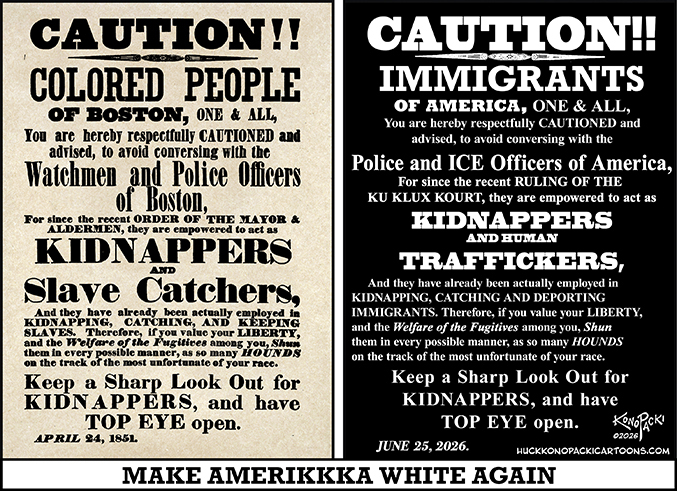
ICE: A Foul and Blasting Conspiracy
By Mike Konopacki
This year marks the 250th anniversary of the Declaration of Independence. The Trump administration’s official celebration emphasizes the nation’s founding ideals and “glorious heritage.” But celebrating American history while ignoring the atrocities committed against human beings in its aftermath does nothing but perpetuate lies. The Declaration itself referred to Indigenous people as “merciless Indian Savages.” The nation that proclaimed liberty continued to enslave millions of Africans and perpetuated nearly a century of Jim Crow segregation and racial violence.
Today, ICE is carrying out an aggressive campaign of arrests and deportations throughout the country. The comparison to the Fugitive Slave Act of 1850 is not mine alone. Columbia Journalism School Dean Jelani Cobb recently examined the striking parallels between resistance to ICE and resistance to slave catchers.
The Fugitive Slave Act required federal officials and citizens to assist in capturing and returning people who had escaped slavery. Anyone who aided a fugitive could face severe penalties. Northern abolitionists responded by creating vigilance committees to protect freedom seekers. In 1850, the Boston Vigilance Committee provided shelter, clothing, money, legal assistance and transportation to hundreds of people escaping slavery.
Detroit provides another powerful example. The city’s Colored Vigilant Committee, founded by Black abolitionists in 1842, helped more than 1,500 fugitives reach Canada during the 1850s. When Giles Rose was arrested in Detroit in 1850, hundreds of Black and white citizens—including people who crossed the river from Canada—mobilized against his removal. Anti-slavery activists ultimately raised $500 to secure his freedom. Michigan later enacted a personal-liberty law restricting state assistance to slave catchers.
Resistance to government-sanctioned injustice can succeed. It took a persistent abolitionist movement and a Civil War to destroy slavery. It took a relentless Civil Rights movement to dismantle Jim Crow. The Selma March helped produce the Voting Rights Act of 1965.
Recently the Fourth Circuit Court of Appeals compared the ICE abuses with the historical “stain” of Japanese internment. “Mass detention of marginalized individuals without due process harkens back to some of the darkest moments in our country’s history,” Judge Nicole Berner wrote.
America eventually acknowledged that injustice. Congress provided limited compensation for property losses in 1948. Later laws restored Social Security and federal civil-service retirement credits lost during incarceration. In 1988, Congress passed the Civil Liberties Act, providing reparations and a formal national apology to surviving Japanese American internees.
Pro-Trump Supreme Court rulings have also drawn the ire of Justice Ketanji Brown Jackson. In her dissent in Trump v. CASA, Jackson warned of a “zone of lawlessness” that permits the creation of a dual state. She cited the work of German Jewish labor lawyer Ernst Fraenkel, whose book The Dual State described the Nazi legal system as divided between a “Prerogative State,” in which the executive exercises arbitrary power and violence against those it targets, and a “Normative State,” in which the favored classes remain protected by the rule of law.
In his condemnation of the Fugitive Slave Act, Frederick Douglass declared: “Human government is for the protection of rights; and when human government destroys human rights, it ceases to be a government, and becomes a foul and blasting conspiracy; and is entitled to no respect whatever.”
The question today is whether America will once again recognize its “historical stain”—or repeat it.
Don’t count on an apology from Trump’s “foul and blasting conspiracy.”